









Film Festivals
Review: ‘Sorry, Baby’—A Bold and Intimate Portrait of Healing and Survival


The 2025 Sundance Film Festival has always been a showcase for daring, deeply personal storytelling, and Eva Victor’s feature debut, Sorry, Baby, is one of the most powerful and emotionally complex films to emerge this year. A darkly humorous, quietly devastating exploration of trauma and resilience, Victor pulls off the rare trifecta of acting, writing, and directing, crafting a film that lingers long after the credits roll.
Set against the backdrop of academia and the emotional aftershocks of sexual violence, Sorry, Baby follows Agnes (Victor), a sharp and self-aware aspiring literature professor, as she navigates the aftermath of a deeply personal violation. The film isn’t about the act itself—Victor intentionally keeps that moment off-screen. Instead, it’s about everything that comes after: the uncomfortable silences, the well-meaning but unhelpful words, the small attempts at regaining control in a world that suddenly feels unsafe.
A Fresh Take on Trauma in Film
Unlike conventional films on this subject, Sorry, Baby isn’t about courtroom battles or revenge—it’s about survival, healing, and the subtle ways trauma reshapes a person’s identity. Agnes doesn’t set out for justice; she simply wants to exist without the weight of her experience defining her. Victor’s screenplay is non-linear, elliptical, dropping viewers into the messiness of recovery rather than holding their hands through neatly structured plot points. It demands engagement, inviting the audience to connect the dots rather than spoon-feeding them dramatic beats.
Agnes’s closest anchor is Lydie (Naomi Ackie), her best friend and roommate, whose unwavering support provides some of the film’s most heartfelt moments. Their bond is playful, deeply rooted, and achingly real—making it all the more painful when life inevitably pulls them in separate directions. As Lydie prepares for motherhood, Agnes finds herself increasingly alone, grappling with the fear of being left behind.
Lucas Hedges delivers a quietly touching performance as Gavin, Agnes’s kind and unassuming neighbor, who provides a rare space where she doesn’t have to explain herself. Their relationship is one of tentative trust, a reminder that not all men are threats, but trust takes time to rebuild. One of the film’s most moving moments sees Agnes and Gavin sitting together in a bathtub—no romance, no expectations—just the simple comfort of shared space.
A Masterclass in Subtle Storytelling
Victor’s direction is both raw and restrained, filled with the kinds of real-life moments that feel too mundane for most films but hit with remarkable authenticity. She trusts her audience to pick up on the unspoken, the weight of silence, and the emotional undercurrents of everyday interactions.
Her storytelling is unconventional—not linear, but elliptical, weaving between Agnes’ present struggles and moments from before her life changed. It’s a film that asks you to lean in, to observe, to connect the dots rather than waiting for exposition. Key events often happen off-screen, leaving Agnes (and the audience) to process their emotional weight after the fact.
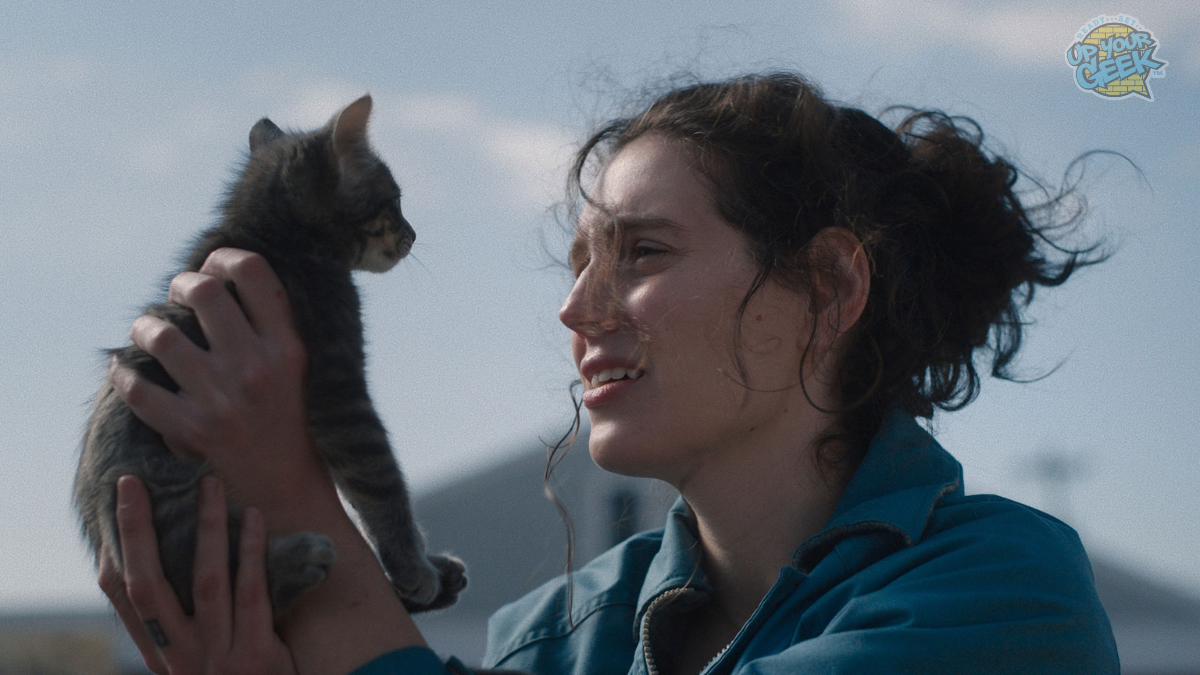
Victor’s sharp comedic background subtly weaves its way into the narrative as well. Humor isn’t forced; rather, it emerges organically in moments of social awkwardness, coping mechanisms, and Agnes’ own dry wit. A scene where she tries (and fails) to hide a stray cat in a supermarket exemplifies this balance—hilarious on the surface but deeply reflective of her need for companionship and control in an uncontrollable world.
Cinematographer Mia Cioffi Henry enhances this intimate approach, framing Agnes’ world in a way that feels both immediate and slightly detached—as if we are watching someone go through the motions, even as they struggle to feel present. The visual language avoids unnecessary dramatization, instead opting for naturalistic lighting and framing that feels lived-in, unpolished, and real.
Victor’s editing choices further highlight Agnes’ emotional state—jumping between present and past, showing moments of joy before cutting back to the numbness of her new reality. This fragmented storytelling mirrors the way trauma lingers, how memories of the past remain sharp while the present feels blurred and uncertain.
A Career-Defining Performance
Victor’s performance as Agnes is nothing short of remarkable. She plays her not as a perfect survivor or a cinematic archetype, but as a fully realized, deeply human woman who is funny, frustrating, brilliant, and broken all at once. Her quirks and contradictions make her feel like someone you know—or maybe someone you are.
The supporting cast, including Kelly McCormack as a jealous colleague and John Carroll Lynch as a kind stranger, all deliver memorable moments, but this is ultimately Victor’s film. Her performance is Oscar-worthy, and with A24 having already picked up the film, Sorry, Baby is poised to make waves far beyond Sundance.
Final Thoughts: A Film That Stays With You
Sorry, Baby is one of the most intelligent, emotionally resonant films of the year. It challenges expectations, leans into discomfort, and dares to present trauma as something ongoing and complex, rather than a problem to be solved. Victor, already known for her sharp comedic writing, proves herself as a filmmaker with a singular voice—one that is warm, observant, and unafraid to leave things unsaid.
As the credits roll, there are no easy answers, no sweeping resolutions. But what Sorry, Baby does leave us with is hope—that Agnes, despite everything, will find a way forward. And in doing so, it ensures that audiences won’t forget her anytime soon.
Rating: 5/5
Where Does ‘Sorry, Baby’ Go from Here?
With A24 already securing distribution, Sorry, Baby is set to reach a much larger audience beyond Sundance. Given its critical acclaim, deeply personal storytelling, and standout performances, the film is bound to be a contender in the upcoming awards season. Victor’s Waldo Salt Screenwriting Award win at Sundance solidifies her as a rising powerhouse in the industry, and with producers Adele Romanski, Mark Ceryak, and Barry Jenkins backing the project, it has the right champions to push it forward.
Much like past Sundance breakouts (Past Lives, Eighth Grade, Manchester by the Sea), Sorry, Baby has the potential to resonate with audiences far beyond the indie film circuit. Its mix of sharp writing, emotional honesty, and nuanced performances ensures it will be one of the most talked-about debuts of the year.
Why ‘Sorry, Baby’ Matters
Victor’s approach to storytelling defies formulaic expectations. Instead of following a traditional arc where trauma is something to be overcome in a clear-cut way, Sorry, Baby embraces the messiness of healing. The film reminds us that progress isn’t always linear, that laughter can exist in pain, and that sometimes, simply moving forward is enough.
It also highlights the importance of representation in filmmaking. Agnes’ story is one that many survivors will see themselves in, and Victor’s commitment to truthful, unsentimental storytelling offers a refreshing alternative to the often-sensationalized portrayals of sexual violence in media.
Final Word: A Sundance Standout Destined for Greatness
Few films manage to be both deeply personal and universally resonant, but Sorry, Baby achieves just that. Eva Victor has crafted a story that is bold, introspective, and darkly funny, proving herself not just as an actor but as a writer and director to watch.
With its brilliant lead performance, sharp script, and unique storytelling approach, Sorry, Baby is not just one of Sundance 2025’s best films—it’s one of the most essential films of the year.





You must be logged in to post a comment Login